
- Social Impact Bond
- Health and wellbeing
- Child and family welfare
- UK
Norfolk, United Kingdom
7 mins
Stronger Families Norfolk
Last updated: 29 Oct 2026
The Stronger Families Norfolk social outcomes partnership (SOP) is funded under the UK Government Department for Digital, Culture, Media and Sport's (DCMS) Life Chances Fund (LCF). The SOP uses Functional Family Therapy for Child Welfare to support families and children in care or on the edge of care.
Project Location
Aligned SDGs
INDIGO Key facts and figures
-
INDIGO project
-
Commissioner
-
Intermediary
-
Investor
- Bank Workers' Charity
- Big Society Capital
- Ceniarth
- Development Bank of Japan
- Global Business Insurer QBE
- Greater Manchester Pension Fund
- Guy's and St Tomas' Charity
- Local government pension schemes
- Merseyside
- Pilotlight
- Project Snowball
- QBE Insurance Group
- The Prince of Wales's Charitable Fund
- Trust for London
-
Provider
-
Funds
-
Launch date
January 2019
-
Start of service provision
February 2019
-
Duration
9 years
-
Capital raised (minimum)
GBP 2.10m
(USD 2.79m)
-
Service users
404
Target population
Children and young people (C&YP) aged 6-15 on the edge of care (who are at risk of being taken into care) or already in care due to abuse or neglect.
The problem
The rising number of children in care is a concerning trend, with over 83,000 children in care in 2023 in England. These children experience significantly worse life outcomes in areas like education, health, and employment compared to their peers. There is also a heightened risk of re-entry into care for those with previous placements. Family dysfunction is identified as a common reason for children entering care, highlighting systemic issues embedded in parent-child communication. At the service level, one of the problems lies in the individualised approach of services that focus on behavioural issues without addressing underlying relational and systemic aspects.
On a larger scale, local authorities face challenges (MacAlister Review, p. 25-27) due to the sheer number of young people in care, causing financial strain and sufficiency issues in sourcing care placements promptly. Keeping children in care is also expensive for local authorities, with some placements costing over £200,000 per year on average (ADCS Report, p. 99).
This situation leads to short-lived care placements, potential family breakdowns, and highlights the need for a shift in local authority spending towards more preventative measures as opposed to crisis interventions.
The solution
Stronger Families - Norfolk is a programme that supports children and teenagers on the edge of care (i.e. who are at risk of being taken into care) or already in care due to abuse or neglect. The intervention used is Family Functional Therapy – Child Welfare (FFT-CW). It seeks to improve communication and supportiveness between parents or guardians and young people, while decreasing hostility.
The local council was interested in funding the intervention in this new way as they were experiencing a pressing need to reduce the number of children in the council’s care to alleviate the strain on their local authority. The council were seeking a culture change around care support, to ensure their financial package could meet this need and to ensure that only the right children remained in care. They were keen to increase support and promote families to remain together where it was safe to do so, thus they started looking into this solution as part of their ‘alternatives to care approach’.
The ‘alternatives to care approach’ was primarily aimed at repurposing the council’s financing, instead of focussing on spending on care proceedings and placements, Norfolk County Council (NCC) instead wanted to prioritise finance for supporting families to stay together. At the time, NCC were seeing a general increase in the number of children coming into care who potentially could be looked after at home safely. Behind this immediate context for Norfolk, there was a wider backdrop of a national and local shortage of social workers.
Norfolk decided to procure the service using an outcomes contract to invite innovation through their procurement approach by specifying the cohort characteristics, intervention type and desired outcomes but without prescribing a specific model of intervention. Additionally, Norfolk also wanted to ensure that there was an embedded continuous ability to change and innovate in the delivery of the programme. Finally, there was a clear aim for the programme to operate on a collaborative basis with in-house operational teams and other partner agencies on the ground.
NCC wanted to bring collaboration and innovation to their support of families from Children’s Services
FFT-CW is a systemic evidence-based model of intervention delivered by skilled staff over 5-6 months of regular weekly sessions with the whole family. This model of intervention is sequentially phased. There is the engagement and motivation phase, followed by the behavioural change phase and the generalisation phase. Hence, progress is measured in every phase of the intervention.
The goal is to engage and motivate families, fostering sustainable behavioural change through the application of systemic family therapy skills and effective communication. The success of the clinical service is viewed as a joint effort, emphasising the importance of coordination and alignment with the system around the young person for optimal impact.
The intervention was not only aimed at achieving substantial cost avoided and cost savings to the local authorities but, more importantly, to improve outcomes for children. The intervention targeted children who could safely be looked after at home, emphasising the importance of empowering parents to make informed decisions about their children's welfare. To address the impact of family breakdowns, practitioners seek to establish strong relationships with families, although tensions between social workers and families can hinder these efforts.
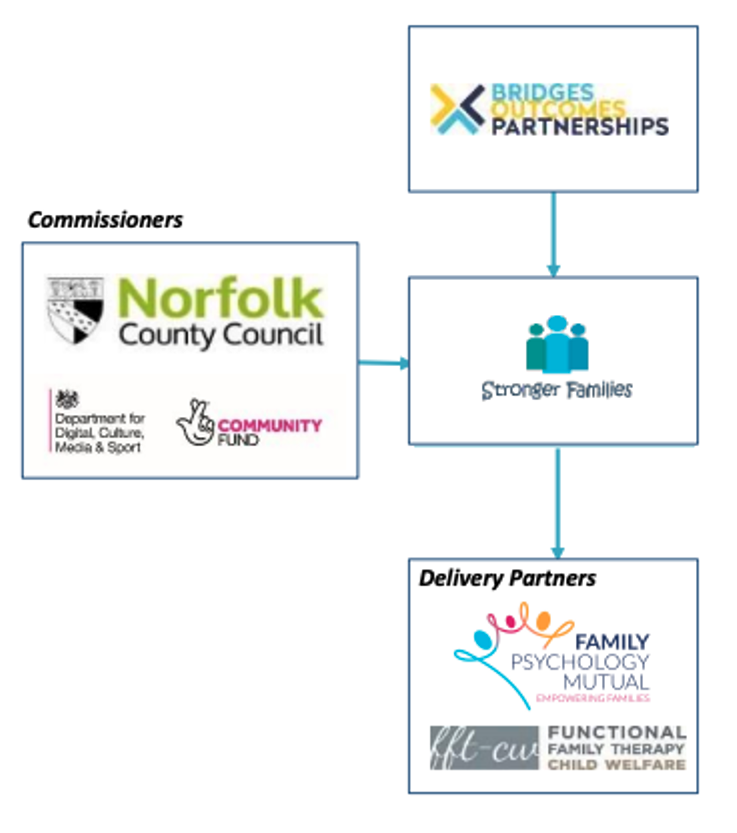
Stronger Families is set up in a partnership with various organisations. This includes being commissioned by Norfolk County Council, the Department of Culture, Media, and Sport, and The National Lottery Community Fund. The delivery and intermediary partners include Family Psychology Mutual, Functional Family Therapy, and Bridges Outcomes Partnerships.
Outcomes payment framework
Payments under this contract are linked to the number of days in care avoided. For the Edge of Care cohort, the council applies a 33% reduction, referred to as 'deadweight', to the number of days eligible for payment. This adjustment accounts for the possibility that children in the Edge of Care cohort might not have entered care regardless of the intervention. For the In Care cohort, no deadweight adjustment applies. The number of days spent out of care is tracked over an 18-month period following the intervention, with payments made for cases deemed trackable.
The impact
As of September 2024, 404 families had either completed or were on track to complete Functional Family Therapy – Child Welfare Adaptation (FFT-CW). Of the families who engaged with the service, 92% remained together. Stronger Families expects 606 families to start the intervention by 2028, with family stability rates projected to remain at current levels.
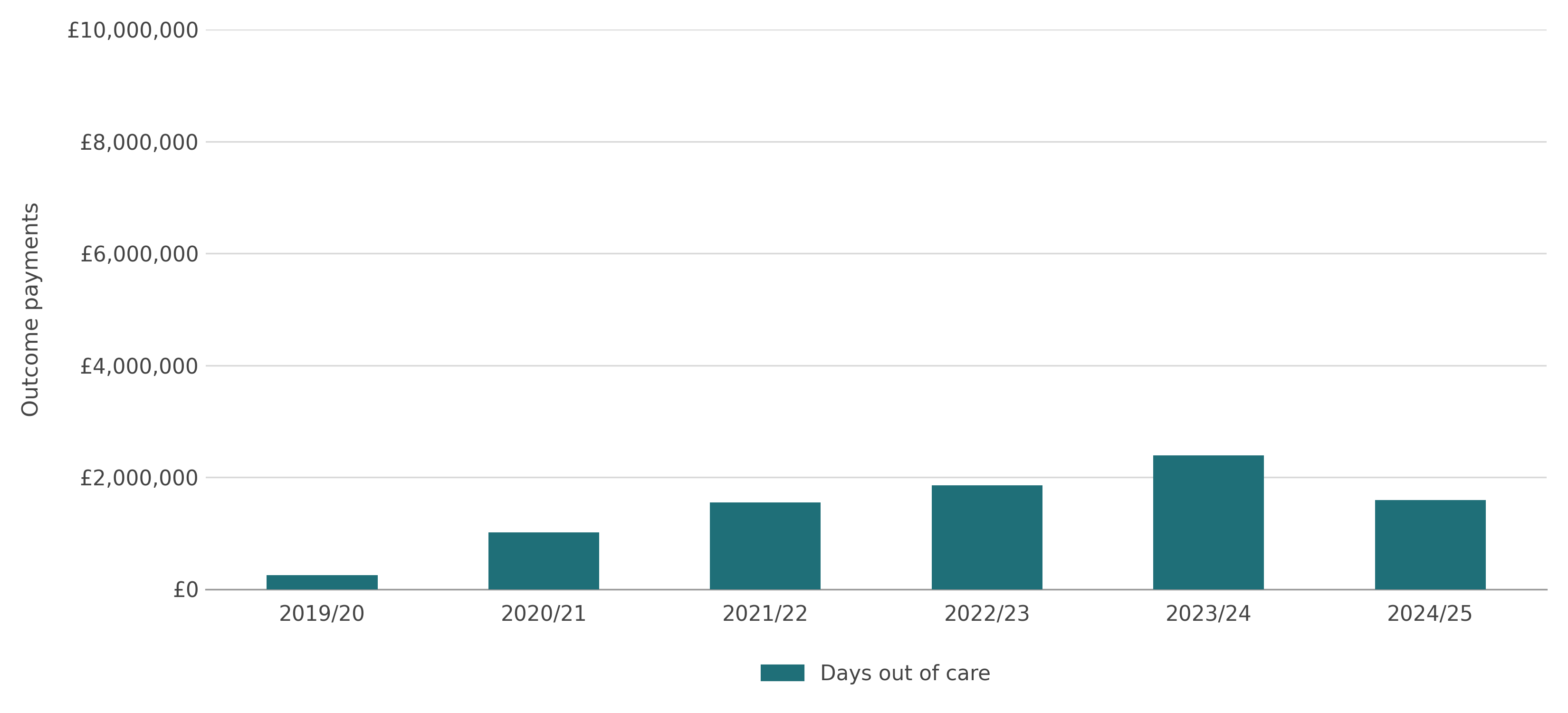
By September 2024, the intervention had helped avoid 145,852 days in care, resulting in approximately £14.9 million in net costs avoided and £2.8 million in net cost savings. Stronger Families had also received £8,626,543 in outcome payments. These figures are based on the End of Grant Report prepared by Stronger Families and shared with its commissioners.
The programme has supported Norfolk County Council in its efforts to reduce the number of children entering care. In 2023, a one-year pilot extension allowed the council to continue supporting children at risk of entering care and expand support for children returning to their families after a period in local authority care.
The service is scheduled to run until January 2028.
Outcome payments for Stronger Families Norfolk 2019-2024
Timeline
-
January 2019
Stronger Families Norfolk outcomes contract signed
-
February 2019
Start date of service provision
-
April 2021
Expanded cohort to include 6 & 7 year olds
-
August 2023
1 year extension agreed with increased focus on family reunifications
-
August 2024
3 year contract extension agreed
-
January 2028
Anticipated end date of service provision
Project insights
Data-informed way of working to enable continuous learning and improvement
For the organisations involved in the delivery of this programme, one of the key learnings has been around the value of using a more data-informed approach which involves not only collecting data but also using it rigorously for both clinical and operational decision-making. The delivery partner, therapists, and social care teams benefit from regular data utilisation, leading to more informed discussions and solutions for improving outcomes.
Therapists are used to traditional clinical questions such as case duration, intensity, and follow-up details. The crucial difference lies in the intensity and robustness of collecting and utilising data. The emphasis is on using data for operational optimisation, going beyond clinical management. Therapists benefit from regular data usage, asking operational questions on a day-to-day basis, and contributing to broader clinical and operational perspectives.
The same data-informed approach applies at a social care level, utilising data to identify problem areas and share them with social care teams. Live data helps identify areas with low referrals or cases that struggle to engage, facilitating quick brainstorming sessions for solutions. The flexibility in including additional interventions (like trauma therapy) is driven by the focus on impact and the overarching goal of supporting families and young individuals within a robust clinical framework.
Shared governance and collaboration between partner organisations
One of the project’s insights is the significance of shared governance and collaboration within partner organisations’ contractual relationships. An initial requirement was for partners, including the delivery partner, social investment coordinators and commissioners, to align on common goals, metrics, and expectations. This was crucial as this collaborative foundation proved vital in achieving impact and success throughout the project.
Stronger Families put shared governance into practice through a centralised referral process, resource allocation meetings and regular meetings between commissioners, delivery partners and social investment coordinators. These arrangements supported ongoing communication, joint monitoring of performance, and a flexible, collaborative approach to addressing emerging challenges and coordinating service delivery.
The overarching lesson is the continuous requirement for communication, negotiation, and mutual understanding throughout the contractual relationship, aligning with the principles of shared governance and collaboration between partner organisations.
Preventative spending model leading to long-term cost savings
The intervention’s ultimate aim was ensuring young people stay out of care. Early investment in families through effective intervention leads to both immediate and long-term cost avoided and cost savings. Immediate cost avoided and cost savings are achieved by avoiding expensive legal proceedings and placements of children in care. The cost avoided and cost savings data mentioned above only incorporates these immediate cost savings which are realized during the 18-month tracking period of the project. The long-term cost avoided and cost savings are realised not only by children’s social care services but also by other stakeholders such as education and physical and mental health. While we know these auxiliary cost avoided and cost savings can be immense, they have not been quantified in project data.
By focusing on preventative interventions and using robust evidence to identify families at risk, there's an opportunity to avoid costs associated with care services downstream. The example of Stronger Families serves as a business case for preventative interventions, emphasising the importance of early intervention and evidence-based strategies to prevent families from reaching critical stages that may lead to higher costs in the future. This approach can be applied more broadly in social care services, leading to both financial savings and improved programme impact.
Contact details
For further information on the Stronger Families project, you can contact:
- Marie Pye, Programme Manager for Stronger Families at Bridges Outcomes Partnership
- Dr Tom Jefford, Director at Family Psychology Mutual CIC
- Faye Moloney, Norfolk County Council
The case study was compiled by Jessica Reedy and Srinithya Nagarajan with support from Bridges Outcomes Partnerships, Family Psychology Mutual and Norfolk County Council,
Last updated: October 2026