Social outcomes partnerships
This guide introduces social outcomes partnerships, explains what they are, how they work, and offers some key practical considerations for their use.
Introduction
1 minute read
Collaboration between government and non-state organisations is well-established within public service provision. Across policy areas, governments increasingly deliver support to citizens through networks of private companies, non-profit organisations, social enterprises, and so on.
Social outcomes partnerships (SOPs) are a model for delivering public services and social programmes based on collaboration between sectors. By invoking strong partnerships between government, private and social sector partners around tangible improvements in outcomes, they focus on real-world impacts and can unlock preventative support.
These models aspire to improve meaningful outcomes, such as sustained employment, improved health and wellbeing, and greater stability. Unlike traditional fee-for-service contracts that pay for activities or inputs regardless of results, social outcomes partnerships focus on achieving real-world impact and enabling earlier, preventative intervention.
Social outcomes partnerships are distinguished from other forms of cross-sector collaboration by two key characteristics: (1) Payment for the achievement of measurable outcomes; and (2) up-front financing from a third party, which is repaid based on the outcomes achieved.
While all social outcomes partnerships share these two features, they vary in their design and ways of working, often adapting to the context in which they are used.
From their inception in 2010, social outcomes partnerships were conceived as a tool to tackle the most complex and entrenched social problems, such as homelessness, long-term unemployment or children on the edge of the care system. Such perennial problems defy simple solutions.
They require an approach that is sensitive to complexity and amenable to innovation and adaptation. Social outcomes partnerships have sought to provide such an approach. They have developed a suite of practices around contracting, data use, governance and performance management, all intended to make services more adaptive, accountable and person-centred.
A note on terminology
Social outcomes partnerships have been known by different names since they originated in 2010. At that time, they were named 'impact bonds', but they have also been referred to as 'pay-for-success', 'social benefit bonds' and 'social outcomes contracts'. The UK government adopted 'social outcomes partnership' as its preferred term in 2023.
What are social outcomes partnerships?
3 minute read
A social outcomes partnership is a collaboration between government and the private and non-profit sectors to improve social outcomes. They originated in the UK in 2010. The first social outcomes partnership delivered a programme in Peterborough prison to reduce re-offending rates. Since then, social outcomes partnerships have been used in diverse policy areas, including education, healthcare, employment support, homelessness support, and environmental policy. They have been implemented in at least 42 countries.
Though social outcomes partnerships vary by design, policy area and context, they all share two key characteristics: (1) payment conditional on the achievement of measurable outcomes; and (2) up-front financing from a third party, which is repaid based on the outcomes achieved. Let's expand on each in turn.
Payment for outcomes. A service delivered using a social outcomes partnership will have one or more pre-agreed measurable outcomes that partners aim to achieve for a specific group of people or community. For example, the first partnership in Peterborough prison aimed to reduce re-offending and captured this by measuring rates of reconviction among cohorts of prisoners. More recently, the 2018-27 Integrated Family Support Service, in Staffordshire, aims to safely prevent children with Child Protection Plans from being taken into local government care.
Usually, a government department sets the intended outcomes and the metrics by which they will be verified, but outcome measures may also be collaboratively developed. Either way, the department that commissioned the social outcomes partnership then pays for the service based on whether the outcomes are achieved or not. Hence, these partnerships are a form of 'outcomes-based contract'. (For more on outcomes-based contracts, and their distinction from other forms of contract, see our separate guidance here).
Up-front finance. The second key characteristic of social outcomes partnerships is the inclusion of up-front third-party financing – an investor in the project. The investor provides sufficient capital for the partnership to operate and deliver services before the agreed outcomes have been achieved (or not). Typically, the investment is structured so that it is only repaid if the agreed outcomes are achieved. Repayment for a social outcomes partnership that meets or exceeds its outcomes targets often includes some additional return on investment. Some partnerships combine funding from multiple investors – the Peterborough prison SOP had 10 investors, for example, with the fund managed by a specialist intermediary.
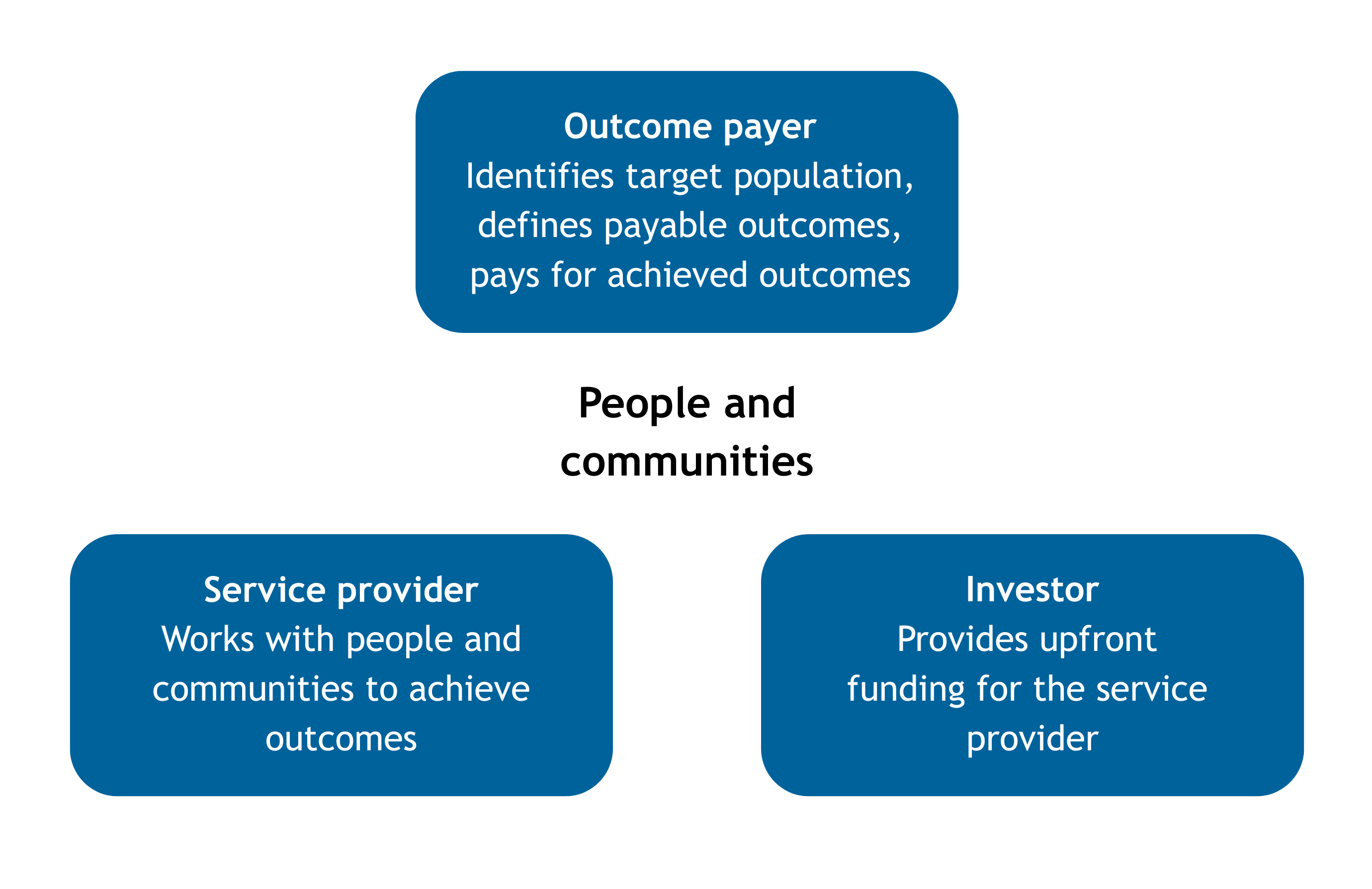
This definition shows that social outcomes partnerships bring together at least three partners: an outcome payer, a service provider and an investor (Figure 1). The outcome payer commissions the project, identifies the social issue they want to address and specifies the outcomes they want to see achieved. They then pay for any outcomes achieved. Outcome payers are often government bodies, but there are cases of philanthropic funds also taking on this role, particularly for international development projects. The service provider works directly with people and communities to achieve the outcomes specified by the outcome payer. Meanwhile, the investor provides up-front funding to the service provider to cover the project's operational costs. Their investment is repaid, sometimes with a return, based on the achievement of outcomes.
In practice, many social outcomes partnerships involve additional organisations, such as technical advisers and independent evaluators. Technical advisers, for example, might support the development of a business case that secures approval from the commissioning authority. Evaluators may conduct the necessary data collection to determine whether a project has achieved its chosen outcomes. The process of designing and implementing a social outcomes partnership draws from the expertise of all stakeholders, as well as community engagement.
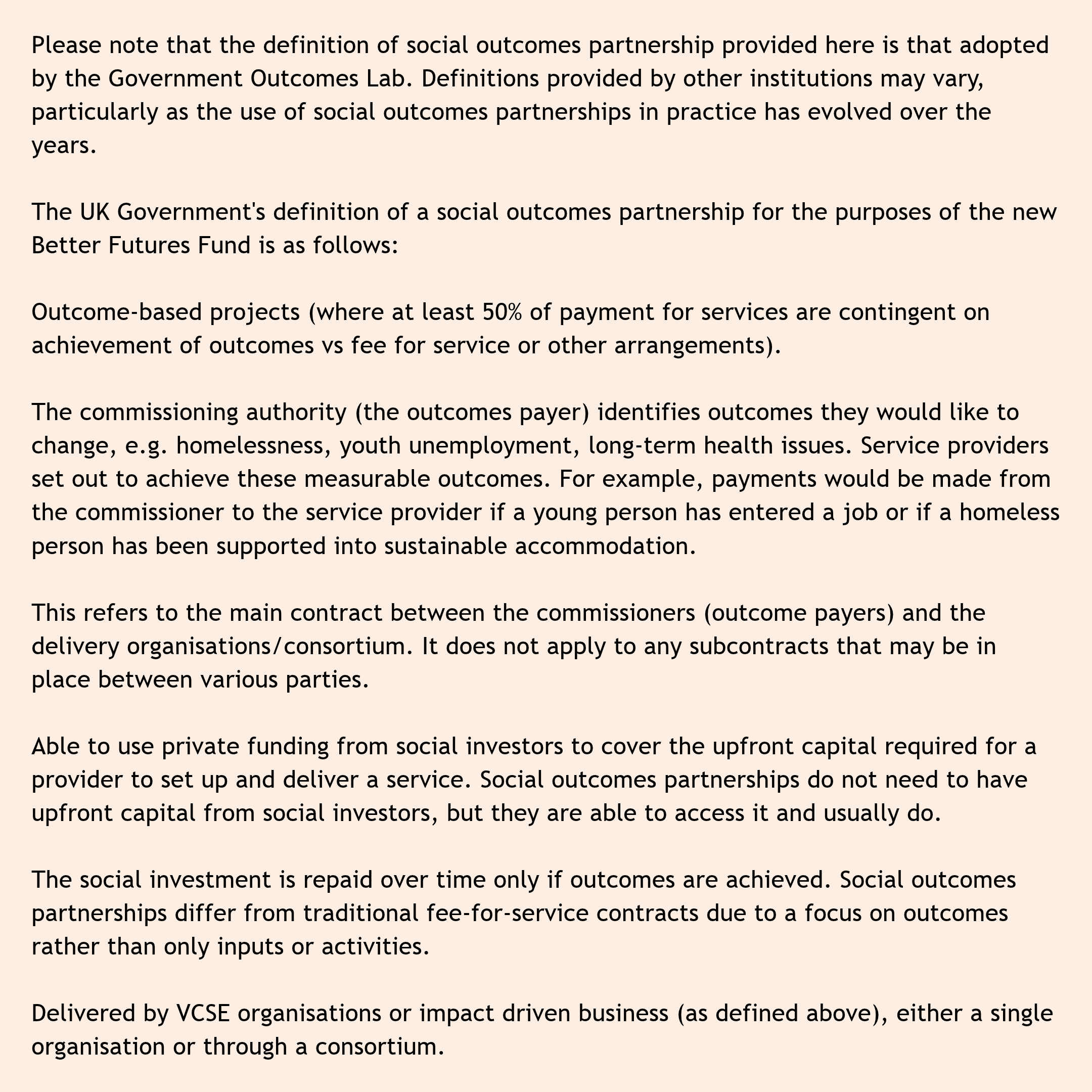
Over the past 15+ years, social outcomes partnerships have evolved. They maintain the characteristics outlined above, but we have seen changes in use case, governance approach and best practice guidance. More than just a financial model, these partnerships have embodied an alternative way of working, used variously to encourage adaptive delivery, channel resources towards preventative services, develop data-led management practices, and so on. They have been adapted to the needs of different policy areas and contexts around the world. Social outcomes partnerships are best defined not as a fixed model, but as a suite of approaches to structuring cross-sector service delivery in the pursuit of better outcomes.
The evidence to date
3 minute read
As social outcomes partnerships have proliferated, a growing body of evidence and resources is now available – reports, evaluations, and datasets that can usefully inform policy and practice.
A good place to start is the GO Lab’s impact bond dataset, which collates key information on over 300 social outcomes partnerships globally. GO Lab also hosts a resource library, featuring many publications on these partnerships. For stakeholders working in the UK context, we particularly recommend these recent reports:
- Transforming public services: Key findings from the evaluation of the Life Chances Fund
- The Evolution of Social Outcomes Partnerships in the UK: Distilling fifteen years of experience from Peterborough to Kirklees
- Commissioning Better Outcomes Independent Evaluation: Synthesis Report
The GO Lab team are happy to answer questions or direct readers to specific resources that may be useful. Get in touch with us at golab@bsg.ox.ac.uk.
Are social outcomes partnerships better than traditional service delivery?
An important question is how a social outcomes partnership compares to delivering the same service using a traditional grant or fee-for-service model. Is this approach better or worse, in terms of outcomes for people and its effect on the service system? This has proved one of the hardest questions to answer, due to a variety of methodological constraints.
Nevertheless, insights can still be derived from the evidence that is available. Qualitative findings about the experience of delivering services through social outcomes partnerships, for example, draw attention to some of the ways in which they differ from traditional approaches. Service providers report increased flexibility as one of the main accomplishments of SOPs, while commissioners highlight the ability to shift spending to prevention. Both report an enhanced ability to serve service users as a main benefit of this approach, with some stating that they could offer a more personalised service when compared to prior approaches.
In terms of impact on service users, GO Lab's evaluation of the Kirklees Better Outcomes Partnership (KBOP) allowed comparison of a service delivered through a social outcomes partnership with the previous 'business-as-usual' service. The Kirklees partnership focused on employment and housing outcomes for vulnerable populations. The evaluation indicated that participants in the partnership were more likely to sustain employment and less likely to require housing benefits than a similar population who received the previous services. (Please note that Kirklees Better Outcomes Partnership was a single intervention, and its positive 'SOP effect' cannot be assumed for social outcomes partnerships as a whole.)
These advantages are balanced by some difficulties. As mentioned above, surveyed stakeholders have reported diversion of time and resources to be a drawback of social outcomes partnerships. This could be due to the relative complexity of designing and managing these arrangements. Evaluation of the Mental Health and Employment Partnership, for example, found that detailed reporting requirements, multi-stakeholder relationship management and intricate payment mechanisms drove higher administrative workload and transaction costs.
A recent review of evidence adds to this a concern that social outcomes partnerships sometimes introduce unintended consequences, such as channelling support to people or projects that are more likely to generate outcome payments, with more difficult cases receiving less support. It is important to be aware of such potential drawbacks so that they can be anticipated and avoided through service design and governance.
Do social outcomes partnerships offer value for money?
A second key question is whether social outcomes partnerships can deliver outcomes at a better price than conventional services. As with quantifying their social impact, this question is difficult to answer conclusively. But, again, there is some evidence that offers at least preliminary insight into the costs of these partnerships. (See this blog post for further discussion.)
Several aspects of social outcomes partnerships incur costs beyond those typically expected with business-as-usual. These include contract design and negotiation, the administrative resources required for data collection and reporting, and the need for independent evaluation to verify outcomes over a long period. Some of these costs may be mitigated, or reduce over time, by appropriately replicating certain features of prior projects. Ultimately, though, the costs need to be divided by the number of positive outcomes achieved. If a social outcomes partnership achieves more outcomes than conventional programming in a particular policy area, then it may have a lower 'cost per outcome' despite higher transaction and delivery costs.
GO Lab's evaluation of the Kirklees Better Outcomes Partnership emphasises this point. In comparison to the services that preceded KBOP, the partnership was more expensive (£23.2 million vs. £17.8 million). However, it engaged more people and achieved better outcomes than the previous services, meaning that the cost per person and cost per outcome were both lower.
Again, the Kirklees Better Outcomes Partnership is a single case, and we cannot infer from this that all social outcomes partnerships deliver improved outcomes at lower per-person cost. But it does demonstrate the potential for such efficiencies to be realised through this model. Policy and practice can learn from the Kirklees approach to try to replicate its cost advantages – but strong data infrastructure and rigorous evaluation are needed to validate the gains and ensure public value.
Key considerations for practice
1 minute read
The evidence suggests that a well-designed and managed social outcomes partnership can enable a more adaptive, person-centred service with a focus on meaningful outcomes. But it should be clear by now that these partnerships are not a simple or quick fix for services struggling to address complex problems. They require careful consideration of both the technical processes involved and the relationships that need to be built and nurtured.
To conclude this introduction, here are some practical considerations for organisations thinking about delivering a service through a social outcomes partnership:
- There should be a clear purpose for using a social outcomes partnership as opposed to conventional forms of delivery. Use cases vary, but each stakeholder should know which benefits they aim to realise through the approach
- Stakeholders should be engaged early and consistently. This is necessary to ensure that there is sufficient appetite among providers and funders, as well as the capability and commitment to deliver the unique aspects of a social outcomes partnership (which may differ considerably from prior practice).
- Desired outcomes should be clearly specified, measurable, and meaningful to people and communities using the service. Social outcomes partnerships place outcomes at the heart of the model, so it’s imperative that the right outcomes are chosen.
- The intended cohort of service users should be defined with clear eligibility criteria. This can help avoid unintended prioritising of ‘easier’ service users who are more likely to trigger payment.
- A robust data strategy is essential. It facilitates real-time decision-making and adaptation, reduces ambiguity in measuring outcomes, and allows for rigorous evaluation to inform subsequent policy and practice.
- The design should allow for flexibility to tailor solutions to local needs and individuals’ ambitions. Such adaptability contributes to a person-centred service and associated better outcomes.
- Throughout, prioritise learning, to better understand how outcomes were achieved, not just whether they were achieved.